






- 113 Views
- 5 Min Read
- (1) Comment
Major highlights
- Intra-African flights cost 45% more than global averages, with passengers paying $68 in taxes versus $32 in Europe.
- High aviation fuel prices, maintenance costs, and airport charges create significant operational barriers for African airlines.
- Africa represents 18% of world population but only 2.1% of global air transport activity due to low demand.
- Poor infrastructure and visa restrictions hinder connectivity, with only 54 of 175 international airports certified by ICAO.
Flying between many of the cities within Africa is anything but smooth. The lack of cheap flights compounds an already complicated process, making seamless intra-Africa travel another painful thorn in Africa’s flesh. Let’s compare this with flights across Europe.
Round trip fares on the London-Paris route, for instance, range from $65 to $340. This journey takes roughly the same time as flying from Nairobi to Zanzibar, yet the African route costs between $235 and $456 round-trip. The cheapest European option costs significantly less than even the lowest African fare.
These comparisons are true for just about any flight route within Africa. And as many have observed, this does more harm than good not just to tourism and trade but also regional integration.
There may be hope on the horizon as some airlines consolidate and the Single African Air Transport Market (SAATM) picks up steam, but how far are we from realising the dream of an easily and cheaply connected Africa?
Barriers to Cheap Flights In Africa: Root Causes

African aviation faces challenges too complex and deeply rooted in structural issues, and this has persisted for decades. It’s unfortunate that to date, intra-African flights are 45% more expensive than flights anywhere across the globe, which creates a significant barrier to continental connectivity. Added burdens such as high taxes, excess charges, and soaring jet fuel costs contribute heavily to this reality.
Taxes, Fees & Charges
A 2024 report on taxes and charges by the African Airlines Association (AFRAA) reveals a pattern that’s been consistent in its previous similar reports. Taxes, charges, and fees for regional departures remain higher in the continent.
“While the average amount of taxes, charges and fees paid by passengers for regional departures in Africa is USD 68, passengers are charged USD 32 in Europe and USD 34 in the Middle East,” the report says.
Over 10 countries, mostly in central and western Africa, charge passengers above USD 100. While the rates have been on an increase in most regions, there’s little to show in the progress of the aviation infrastructure. Eventually, these taxes impede passenger demand, restrict route growth, and hinder the overall economic growth that aviation can stimulate.
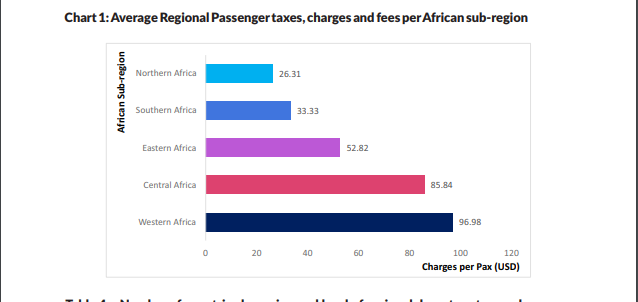
Chart showing comparisons on taxes, charges and fees between different sub-regions in Africa. File: AFRAA
Aviation Fuel Prices
Aviation fuel prices, according to the Air Transport Association (IATA), can be 17% higher in Africa than elsewhere. Insurance and maintenance aren’t cheap either, with costs exceeding the global average by 6% to 10%.
Ladislaus Everist Matindi, who recently retired from his position as CEO of Tanzania’s national carrier, noted a few years earlier, that low cost carriers(LCC) in Africa may never be realised due to the continent’s operating environment, which to him not only includes high maintenance and fuel costs but also high airport charges and low traffic volume.
“This [LCC model] doesn’t work in Africa due to the operating environment, and if it did, every airline would opt for it,” he says, his recommendation being that operating costs need to be minimised as much as possible.
Low Passenger Demand and Numbers

Africa accounts for roughly 18% of the world’s population, yet this share is far from being reflected in its air transport sector. According to IATA, the continent’s air transport activities – both cargo and passenger – account for just 2.1% of worldwide traffic.
Connectivity within some regions such as Northern Africa may be relatively better (67%) but inter-regional travel still lags, mostly due to regulatory barriers and high tax and operational costs.
Kirby Gordon from South Africa Low Cost Airline adds that the low demand and passenger numbers on many routes forces the use of smaller aircraft, which aren’t as efficient as jets, eventually leading to higher ticket prices and limited economies of scale.
Visa Restrictions
Visa restrictions and poor infrastructure don’t make the case for cheap flights in Africa any easier. Many countries within the continent remained closed off to each other, which makes travel within the continent difficult.
As of mid-2025, only five African countries grant visa-free access to all African passport holders. Kenya is the latest country to join Benin, The Gambia, Rwanda, and Seychelles in giving visa-free entry for citizens of nearly all African nations.
Looking at the broader picture, there is still very little progress. For over 60% of the African countries, citizens of the contingent require them. Several other nations offer varying degrees of visa openness for African citizens, with progress steadily increasing due to initiatives like the African Union’s Free Movement Protocol.
Poor Infrastructure
In December 2019, the International Civil Aviation Organization (ICAO) reported that only 54 out of 175 international aerodromes in Africa were certified, representing about 30.8% of the total. Despite high taxes and charges on air travel by some countries, the funds are rarely directed at improving the aviation infrastructure.
That said, some African countries are making progress by investing in modern aviation infrastructure. Ethiopia, for example, has begun constructing a new mega airport, while nations like Nigeria, Rwanda, Senegal, Côte d’Ivoire, Egypt, and Morocco are undertaking similar projects.
Efforts on bilateral air service agreements, like the launch of the Single African Air Transport Market (SAATM), have been made in recent years in an effort to deregulate aviation by liberalising air travel across Africa so as to realise cheap flights across the continent and increase access, but can this hack it?
Read our article on the Single African Air Transport Market to learn more



Comment 01
jollibee777,
12 December, 2025Understanding game odds is key to enjoying any casino experience! It’s great to see platforms like Jollibee777 focusing on community & fun. If you’re in the Philippines, check out jollibee777 download for a wide range of games and a welcoming vibe! 👍